Sometimes it isn't the glitzy, glamorous pigments or brilliant colours that deserve the most admiration.
Sometimes it's the quiet, foundational things.
You know...Like trees….Or paper.
Part Two of the "Oh My God... I Love Paper" series.
There once was an artist quite bright,
Who painted from morning till night.
The colours filled him with bliss,
But the paper said, "Watch this!"
And then it buckled with all of its might.
Why Does Watercolour Paper Buckle?
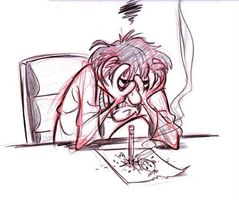
If you've ever watched your beautiful flat sheet of paper transform into the Rocky Mountains halfway through a painting, you've experienced buckling.
Buckling happens because paper fibres swell as they absorb water. The more water you use, the more those fibres expand. If they can't expand evenly, the paper begins to ripple, wave, and generally make life interesting.
The easiest way to reduce buckling? Use heavier paper.
Does Paper Weight Really Matter?
Absolutely.
Paper weight is usually measured in pounds (lb) or grams per square metre (gsm).
90 lb (190 gsm):
Light and economical but prone to buckling with wet washes.
140 lb (300 gsm):
The most popular choice. It handles most watercolour techniques beautifully.
300 lb (640 gsm):
Thick, luxurious, and remarkably resistant to buckling. It also comes with a price tag that may require a small moment of silence.
As a general rule, the more water you use, the heavier your paper should be.
To Stretch or Not to Stretch?
That is the question.
Stretching paper simply means soaking it with water, securing it to a board, and letting it dry under tension before you begin painting. The idea is that the paper has already expanded, so when you add washes later it stays much flatter instead of buckling and waving all over the place. It really does work...but it is also a bit of a production.
When inspiration finally arrives, it rarely announces itself with, "No rush. Go stretch your paper. I'll wait."
Stretching means gathering a board, water, tape or staples, finding somewhere to let it dry, and having just enough patience to start wondering why you didn't simply buy heavier paper in the first place.
Many artists happily stretch 140 lb paper, especially for large paintings or very wet techniques.
Many artists happily don't.
There's no rule that says you must stretch your paper. Plenty of painters simply tape the edges to a board, accept a little movement, and flatten the finished painting later.
If you prefer to skip the whole stretching ritual, 300 lb paper is wonderfully well behaved and often doesn't need stretching at all.
A Hues Tip
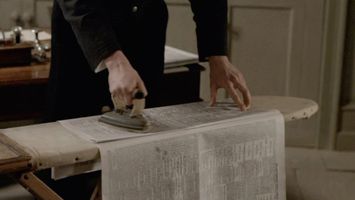
If you're just beginning with watercolour, don't let buckling discourage you. Experienced artists occasionally watch a painting develop a few unexpected hills and valleys. Even butlers know how resilient paper can be. even if it wrinkles....you can iron it out.

So What Is Sizing?
Despite the name, sizing has nothing to do with the dimensions of a sheet of paper. It is a nearly invisible treatment that controls how quickly water is absorbed into the paper. Without it, watercolour would soak into the fibres almost instantly, making soft washes difficult to control, colours dull, and lifting nearly impossible.
A Brief History of Sizing
The earliest paper was invented in China around A.D. 105, traditionally credited to the court official Cai Lun. Those early papers were wonderfully absorbent, making them ideal for writing and calligraphy with ink.
As papermaking spread west through the Islamic world and eventually into Europe, artists began using paper for new purposes, including watercolour. They quickly discovered that untreated paper behaved more like blotting paper than a painting surface.
By the 13th century, European papermakers had developed a solution. They began coating finished sheets with animal gelatin, made by boiling collagen from hides and bones. This process became known as gelatin sizing.
It was a simple idea with a remarkable effect.
Instead of water disappearing immediately into the fibres, paint remained on the surface long enough for artists to create smooth washes, soft blends, crisp edges, and delicate glazes. In many ways, sizing helped transform watercolour into the painting medium we know today.
Sizing Today
Here's something you probably never expected to hear:
Some watercolour papers aren't vegetarian.
Traditional premium papers often use gelatin sizing, while many modern papers use synthetic sizing, offering a vegan-friendly alternative.
Most quality watercolour papers contain two kinds of sizing:
Internal sizing
is mixed into the paper pulp, giving every fibre some water resistance.
Surface sizing
is applied after the sheet is made, creating the durable painting surface artists depend on for washes, lifting, glazing, and scrubbing.
Watercolor Paper Personality
Painting is more than colour and composition. It's also a tactile experience. The feel of your brush moving across the paper is something every painter experiences, even if they can't quite put it into words. That's why surface texture isn't simply a technical specification—it's a personal choice. And when you know....you know.
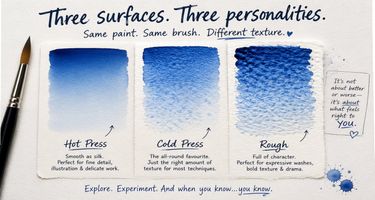
Watercolour paper is divided into basically three different surface textures hot press, cold press and rough and if you have ever wondered why they were named that way,
it's actually one of those wonderful pieces of papermaking history that has survived long after the machinery changed.
Hot Press
Hot Press (HP) paper is passed through heated metal rollers (called calender rolls) after it is made. The combination of heat and pressure compresses the surface fibres, producing a very smooth finish.
The name literally comes from the paper being pressed while the rollers are hot.
Cold Press
Cold Press (CP) paper is also pressed between rollers, but without heat. Because the fibres aren't compressed as much, the paper retains a gentle texture (often called "tooth").
This is why Cold Press sits nicely between Hot Press and Rough.
Rough
Rough paper is the easiest to explain because it isn't heavily pressed after it leaves the mould. The natural texture created during papermaking remains largely intact, giving it its distinctive peaks and valleys.
Meet the Watercolour Family
Decisions Decisions.....
Just when you think you've finally chosen your paper, someone asks:
"Would you like that in a pad, a block, a sheet...or a roll?"
At this point it's perfectly reasonable to wonder whether you're buying art supplies or ordering wallpaper.
Pads
Pads are the easiest place to begin. The sheets are glued along one edge and tear away as you need them. They're convenient, affordable, and available in almost every size.
Blocks
Blocks are the clever cousins of pads. Instead of being glued along one edge, the paper is glued on all four sides, holding it under gentle tension while you paint. The result? Less buckling, no stretching, no masking tape, and the freedom to paint right to the very edge of the paper.
When you're finished, simply slide a palette knife into the small opening around the edge and separate your painting from the block.
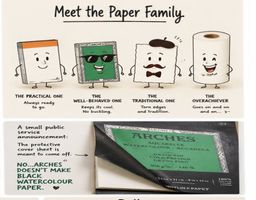
A small public service announcement: The protective cover sheet on many watercolour blocks is just that—a protective cover sheet. It is meant to come off. No, Arches doesn't make black watercolour paper.
Sheets
Many experienced artists tear them down into half sheets, quarter sheets, or whatever size a project requires.
Notice we said tear, not cut.
Among traditional watercolour artists, cutting a full sheet with scissors or a paper cutter borders on sacrilege. A proper deckled tear leaves a beautiful feathered edge that has become part of the character of watercolour painting.
If you'd like to learn how to tear a sheet properly, the Hues staff would be delighted to show you. We promise it's easier than it looks.
Rolls
Rolls are also available (Special Order)...for artists with ambitious ideas and bank accounts sturdy enough to support them.
Whether you choose a pad, block, sheet, or roll, remember that they're all exactly the same paper. The only difference is how it arrives at your studio. Choose the format that suits the way you like to work.
Next time in the "Oh My God...I Love Paper" series...
The Great Paper Debate and
The Case of Cotton vs. Wood Pulp
Honourable Judge Paul Easel presiding.