
This October we are offering our paper at 25% off!!!
Made Here. Made for Making
There are some remarkable art materials being made right here in Canada. From canvas and charcoal to handmade watercolour, professional acrylics and traditional painting materials, Canadian makers are producing materials worthy of the people who use them.
At Hues, we're proud to carry five of them. Each has a different story, a different way of making, and a different place in the Canadian art-materials landscape. Come meet them.
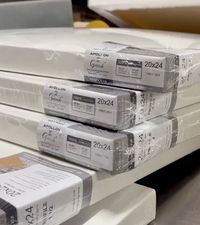
Where the Painting Begins
Apollon/Gotrick
Long before the first brushstroke, there is the surface. Since 1967, Quebec-based Apollon Gotrick has been making those surfaces for Canadian artists. What began as a family business rooted in custom framing grew under a second generation into a Canadian manufacturer specializing in the foundations on which paintings are made — canvas, panels, stretcher bars and painting surfaces.
What makes Apollon particularly interesting is the breadth of what they make. Their canvases range from traditional cotton surfaces to deep gallery profiles, black canvas and pure linen, with different weights, textures and priming designed for different ways of working. Their standard artist canvas, for example, begins with 7 oz pure cotton and is double-primed to a finished weight of 15 oz; their linen canvases use 9 oz pure linen and are triple-primed to a finished 17 oz. It's an unglamorous part of painting that matters enormously: a good painting deserves a good place to begin.
By Artists, For Artists
Kama Pigments
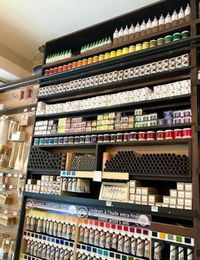
Kama Pigments began in 1996 in a Montreal semi-basement apartment, when founder Vincent Deshaies set out with a fairly ambitious idea: make the raw materials of traditional painting — particularly dry pigments — accessible to artists, and give them the knowledge to make their own colours and mediums. From those modest beginnings, Kama grew into a remarkable resource for painters, with a catalogue encompassing pigments, drying oils, natural resins, gums, waxes, gilding materials and other ingredients that reach right back into the traditions of paint-making. Just as importantly, sharing the knowledge of how those materials work has remained part of the company's philosophy.
But Kama doesn't only help artists make paint — they make it themselves. In Montreal, they manufacture their own professional oil colours, oil sticks, encaustics, graphite and painting mediums. Their oil colour alone took eight years to develop; each colour is individually formulated with pigments selected for qualities such as luminosity, stability and saturation, and the colours are made with walnut oil to reduce yellowing. It's a company where the science of materials and the practice of making art are unusually intertwined. Perhaps that's why their motto feels particularly appropriate: “By artists, for artists.”
From the back of an Art Store
Tri Art Manufacturing
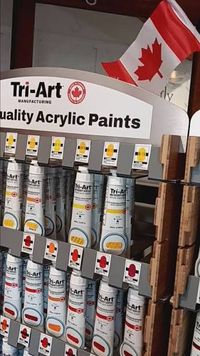
In 1994, in the back of a small art supply store and gallery called Art Noise in Kingston, Ontario, three people began making acrylic paint in a space of about 100 square feet. That little paint-making operation became Tri-Art Manufacturing, still family-run and still in Kingston. More than thirty years later, Tri-Art has grown into a major Canadian manufacturer, employing more than 60 people and producing over 20 different paint lines. Their materials now travel to artists in more than 30 countries — but the paint is still made in Kingston.
What makes Tri-Art especially interesting is that they are not simply a Canadian brand with their name put on somebody else's paint. They actually make it. Pigments are ground, paint is formulated and milled, batches are tested, and products are filled and labelled under the same roof. They even manufacture much of their own packaging. That control allows Tri-Art to concentrate on what matters inside the jar: finely milled pigments, strong colour and carefully formulated artist materials. And while acrylic colour remains at the heart of the company, that original experiment in the back of an art store has grown to include watercolour, oils, inks, mediums, specialty paints and surfaces.
Colour from the Prairies
Stoneground Paint Co.
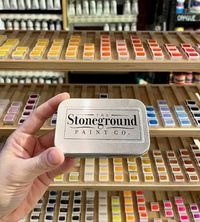
Founded in 2017 by Canadian watercolour artist Eric Rowe and his daughter Jenny, Stoneground Paint Co. makes its watercolour and gouache here in Saskatchewan. Eric is a self-taught Regina artist inspired by the landscape of Western Canada, while Jenny brings a background in Art History and History to the company, researching pigments and botanical subjects that help inspire the colours they create. It's a lovely combination: the practicing artist and the student of the history and materials of art, making paint together on the Prairies.
And they really do make the paint. Stoneground works in small batches using traditional methods, grinding pigment into a binder of gum arabic and locally sourced prairie honey. The paint is mulled by hand on a stone slab, and individual pans are poured gradually over several weeks. They deliberately avoid fillers, extenders and preservatives, with the aim of keeping the colours luminous and pigment-rich. Their range wanders wonderfully through the history of colour too — modern pigments sit alongside traditional earth colours, naturally occurring mineral pigments, metallics and pearlescents.
A tradition worth saving
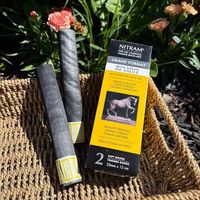
Nitram Charcoal
Nitram had long been regarded as an exceptional fine-art charcoal, particularly among artists trained in classical drawing. But eventually the French maker stopped producing it, and Nitram all but disappeared. Canadian artist Jerzy Niedojadlo discovered this when, while studying at the Academy of Art in Toronto, an instructor recommended Nitram for his first charcoal cast drawing — only for Jerzy to discover that he couldn't actually buy it anywhere. Rather than accept that, he tracked down the former maker in France. What began as an exchange of emails eventually led Jerzy and his partner Patricia to travel to France, purchase the Nitram process, equipment and trademark, and spend time learning exactly how the charcoal had traditionally been made. In 2011, the equipment was packed into a 40-foot container and shipped to Canada, where production began again.
What Jerzy went to all that trouble to preserve is a charcoal quite different from ordinary willow or vine. Nitram's manufacturing process maintains the cellular structure of the wood, producing charcoal that is stronger, less brittle and considerably less dusty, yet can still deliver deep blacks and a broad tonal range. It is also made in different grades — H, HB and B — allowing an artist to move from a fine, sharpened point and delicate values to rich, soft darks. Today Nitram is once again used by drawing ateliers and artists around the world, but it is made in Canada. There is something rather wonderful about that: an artist loved a material enough to make sure it didn't disappear.