Amber Bryans
Meet Amber
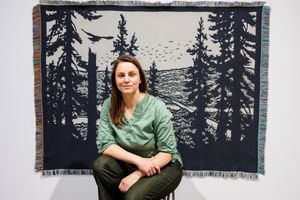
Amber Bryans practices printmaking and painting out of her home studio in Saskatoon. She works using manual processes that are by nature tactile and slow, bringing craftsmanship, attention, and thoughtfulness to her works.
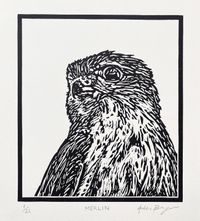
Amber’s linocuts, monoprints, and paintings use natural imagery to create quiet spaces that encourage personal reflection and foster appreciation for the environment. Drawing from a wealth of impressions of Saskatchewan’s prairies and forests, she seeks to capture the feeling of these places and some of their wild inhabitants.
Amber holds a Bachelor of Fine Arts in Studio Art from the University of Saskatchewan. She is passionate about connecting people with the arts, and in recent years has engaged in outreach-focused residencies, led community arts programming, and participated in local exhibitions.
A few questions with Amber
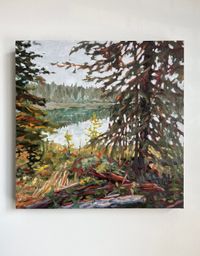
(left: Lakeside. OIl on panel, 12"x12")
How did you first become interested in art?
I’ve always been interested in art! I grew up in a family that celebrated all creative arts, and as a child I enjoyed crafting and drawing etc. The arts were always a part of my life, and I knew that making/creating with my hands would always be there.
But becoming a professional artist? There were a few pivotal moments that led to this career path. Most notably: my 19 year old self in a first year university painting class elective. My professor stopped at my work during a studio session and said something like, “Huh, you have a knack for this, you should keep painting in the future.” I then overreacted to this comment by making Visual Arts my whole undergraduate degree.
How has your artistic education or training influenced your work?
My BFA really helped me to gain visual perception and understanding. It forced me to shift from making individual artworks to thinking more broadly: creating a “body of work” and developing skills and experimentation in a series over time. I gained a vocabulary to talk about art, “read” artworks, participate in critiques, and mainly to be able to think critically about my work. On the technical side, it was a good starting point for learning to set up strong compositions, colour mixing, use of scale, and getting familiar with my materials.
What inspires your work today?
My work today is mostly inspired by nature. I paint landscapes, mainly, as well as monoprints from plants, and linocuts of birds. I make art about nature I see and places I interact with. I really appreciate images that are contemplative or meditative, and I try to bring those feelings to my work.
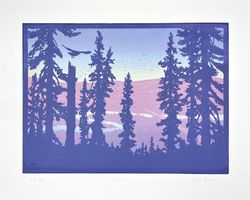
(right: Return. Linocut on paper, 16"x20")
What do you enjoy most about teaching?
It really gives me a thrill to be able to walk alongside someone else and see them gain a new skill or understanding. The world is a marvellous place and teaching lets me share a bit of that wonder and curiosity with others.
What can a new student expect in your class?
I try to set up my classes in a way that balances technique with creativity. I include in all my classes some skill-building content, some structured steps for application, and creative off-ramps for people to do their own thing. I welcome questions and experimentation, and I am available to work through issues as they come up. I hope that my classes can be a safe space for students regardless of their confidence level or artistic experience.
What advice would you give someone taking their first art class?
Be kind to yourself. There will be a lot of artworks that you make that you might not “like,” but as you make more, you will learn it doesn’t matter. You are learning and you’ll make more art, and the skills will come eventually for you to get the materials to do what you want them to.
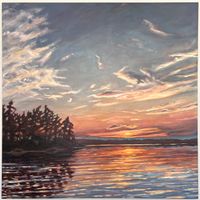
(left: Golden Sunshine. OIl on canvas, 48"x48")
What do you hope students take away from your classes?
I hope my students walk away with a few new skills, confidence to keep experimenting on their own, and ideas for things they want to try with their art.
How do you continue to grow as an artist?
Through curiosity, exploration, and showing up.
I spend time in nature, go see art, get to know other artists and ask them questions about how they do things. I experiment with new materials. I start projects that stretch the boundaries of my technical skills. I do exercises like making colour mixing charts to get to know my pigments better. I critique my own work as fair as I can and consider what I would like to do more of and what I would like to change next time. Also, I try to embrace the seasons and use summer for research with my sketchbook, and the winters for larger works in the studio.
What is something people often misunderstand about art or creativity?
People often are way too hard on themselves before they’ve even started. They perceive a “good artwork” as the goal, and shoot themselves in the foot because there is no room for failure. The best creative sessions happen when the stakes are low and we don’t care about the outcome so much.
For every amazing artwork online, there is a closet graveyard of art rejects and a sketchbook of experiments that came before it. And all of it has value. Technical skills can be learned over time with practice. Creativity comes with space to play. Turn off the inner critic and give it a try-permission to just mess around and make stuff.
Learn with Amber
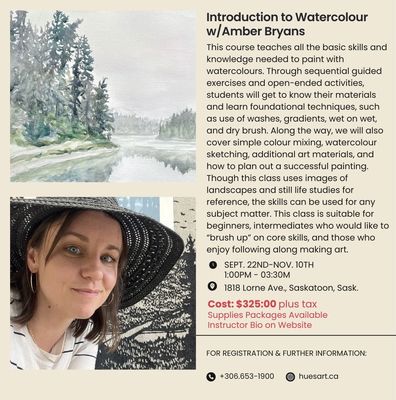
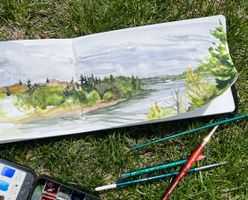
Learn watercolour painting with Amber Bryans
We are pleased to have Amber teaching in our classroom. If you're interested in learning the fundamentals of watercolour painting, consider signing up for Amber's Watercolour class.